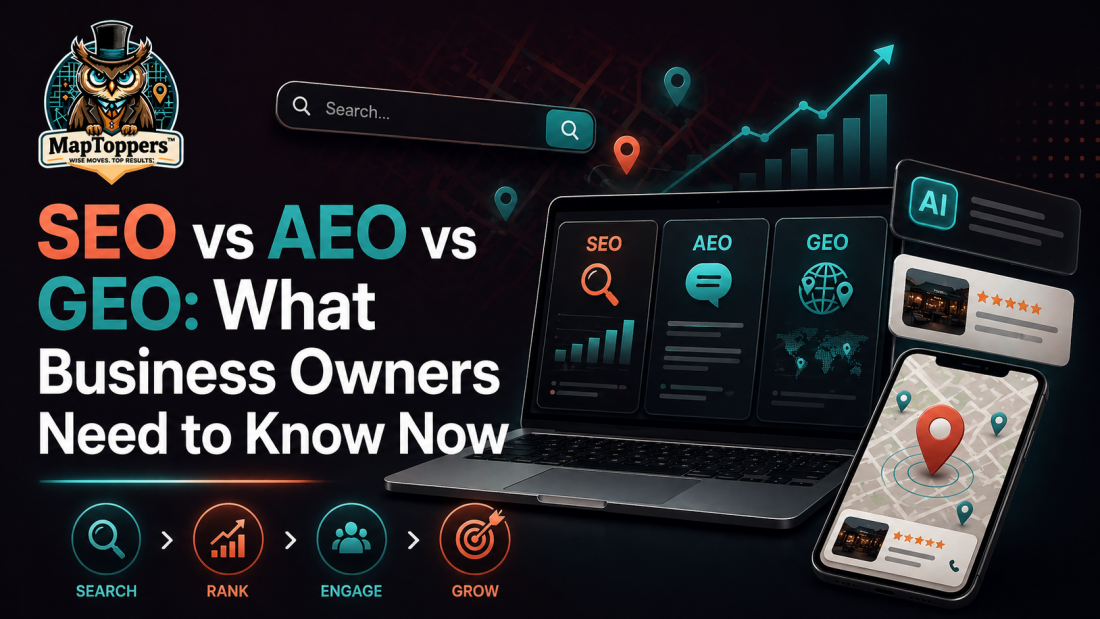
SEO vs AEO vs GEO: What Business Owners Need to Know Now
Search is changing, and if you own a business, you have probably felt it.
For years, the main goal was simple: show up on Google.
You wanted your website to rank. You wanted your Google Business Profile to appear in the local map pack. You wanted more calls, more clicks, and more people finding your business instead of your competitors.
That still matters.
But now, customers are searching in new ways.
They are asking full questions. They are using voice search. They are reading AI-generated answers. They are using tools like ChatGPT, Gemini, Perplexity, and Google AI results to compare businesses, understand services, and make decisions faster.
That is why business owners are now hearing three important terms:
- SEO
- AEO
- GEO
At first, they may sound like another round of digital marketing alphabet soup. But the idea is actually simple.
SEO helps your business rank.
AEO helps your business answer.
GEO helps your business get understood and found by AI.
If you are a local business owner, service provider, contractor, medical or dental practice, real estate professional, or small business trying to get more visibility online, these three concepts matter.
The good news? You do not need to throw away your current marketing strategy.
You just need to understand how search is evolving and how your business can stay visible.
What Is SEO?
SEO stands for Search Engine Optimization.
It is the process of improving your website and online presence so your business can show up higher in search engines like Google.
For local businesses, SEO helps you appear when people search for services in your area.
Examples include:
- “plumber near me”
- “dentist in Queens”
- “local SEO company”
- “pressure washing Savannah GA”
- “court reporter Sarasota”
- “roof repair near me”
- “Google Business Profile SEO”
- “local SEO services”
SEO helps Google understand:
- Who your business is
- What services you offer
- Where you provide those services
- Why your business is trustworthy
- Which searches your website should appear for
For small businesses, SEO is still one of the most important parts of digital marketing.
Why?
Because people still go to Google when they need something.
They search before they call.
They compare before they book.
They read reviews before they trust.
They check your website before they make a decision.
So yes, SEO is still very much alive.
It is just no longer the only piece of the visibility puzzle.
What Is AEO?
AEO stands for Answer Engine Optimization.
AEO is about making your content easy to understand and easy to use as an answer.
Instead of only thinking about keywords, AEO focuses on the questions your customers are asking.
For example:
- “What is local SEO?”
- “How long does SEO take?”
- “Why is my Google Business Profile not ranking?”
- “How much does pressure washing cost?”
- “Is a game truck better than a bounce house?”
- “How do I choose the right dentist?”
- “What should I look for before hiring a contractor?”
These are not just keywords.
They are real questions from real people who are trying to make decisions.
AEO helps your website answer those questions clearly.
This matters because search engines and AI-powered tools often look for direct, helpful answers. If your content is clear, organized, and useful, it has a better chance of showing up in answer-style results.
AEO can support:
- Featured snippets
- FAQ results
- Voice search
- Google AI answers
- Blog visibility
- Service page visibility
- Customer trust
- Conversion rates
In simple terms, AEO helps your business become the helpful answer customers are looking for.
What Is GEO?
GEO stands for Generative Engine Optimization.
This is the newest of the three.
GEO is about helping your business become easier for AI-powered tools to understand, summarize, mention, or reference.
Generative search tools include platforms and features such as:
- ChatGPT
- Gemini
- Perplexity
- Claude
- Bing Copilot
- Google AI Overviews
- Other AI-powered search tools
These tools do not always work like traditional search engines.
Instead of showing a long list of links, they often generate a full answer for the user.
For example, someone may ask:
- “What is the best marketing strategy for a local service business?”
- “How can a small business improve Google visibility?”
- “What should I look for in a local SEO company?”
- “How do I know if my Google Business Profile is optimized?”
- “What is the difference between SEO, AEO, and GEO?”
AI tools may respond with a summary, checklist, explanation, recommendation, or list of possible sources.
GEO helps your business prepare for that kind of search.
It focuses on making your content:
- Clear
- Helpful
- Well-structured
- Trustworthy
- Specific
- Easy to summarize
- Easy to understand
- Supported by strong brand signals
The goal of GEO is not to “trick” AI.
The goal is to make your business and content so clear that both humans and AI tools can understand what you do, who you help, and why you are credible.
SEO vs AEO vs GEO: The Simple Difference
Here is the easiest way to understand the difference.
SEO Helps You Rank
SEO focuses on traditional search visibility.
It helps your business show up in:
- Google Search
- Google Maps
- Organic search results
- Local map pack results
- Service-related searches
- Location-based searches
SEO is best for:
- Ranking service pages
- Ranking location pages
- Improving website traffic
- Improving Google Business Profile visibility
- Getting found by nearby customers
- Building long-term search visibility
Example:
A homeowner searches “roof repair near me.”
SEO helps a roofing company appear in Google search results and Google Maps.
AEO Helps You Answer
AEO focuses on answering questions clearly.
It helps your business show up when people ask:
- What is this?
- How does this work?
- How much does it cost?
- Is this worth it?
- What should I choose?
- What are the signs I need this service?
- How do I compare my options?
AEO is best for:
- FAQs
- Blog posts
- How-to guides
- Comparison content
- Featured snippets
- Voice search
- Educational content
- Customer decision-making
Example:
A homeowner searches “how do I know if I need roof repair?”
AEO helps the roofing company provide a clear, helpful answer.
GEO Helps AI Understand Your Business
GEO focuses on AI-powered search and generated answers.
It helps your business become easier for AI tools to understand.
GEO is best for:
- AI search visibility
- Brand mentions
- Clear service explanations
- Expert content
- Trust-building pages
- Structured content
- Helpful educational resources
- Strong online credibility
Example:
A homeowner asks an AI tool, “What should I look for before hiring a roofing company?”
GEO helps the roofing company’s content become useful, clear, and trustworthy enough to be understood in that type of AI-driven search journey.
Why Business Owners Should Care
This matters because customer behavior is changing.
People are no longer searching in only one way.
Today, customers may use:
- Short Google searches
- “Near me” searches
- Full question searches
- Voice search
- AI tools
- Google Maps
- Review platforms
- Social media
- Comparison searches
- Problem-based searches
A customer may not simply type:
“local SEO company”
They may ask:
“What is the best way for my small business to rank higher on Google?”
Or:
“Why is my competitor showing up before me on Google Maps?”
Or:
“How do I know if my website is hurting my leads?”
This is why your business needs content that does more than repeat keywords.
Your content needs to educate, answer, explain, and build trust.
Visibility Is Bigger Than Rankings Now
Ranking on Google is still important.
But online visibility now includes more than just being on page one.
Your business visibility may include:
- Google Search results
- Google Maps
- Google Business Profile
- Website content
- Blog articles
- FAQs
- Featured snippets
- AI-generated answers
- Reviews
- Local listings
- Social media profiles
- Directory mentions
- Brand mentions
- Customer testimonials
The real goal is not just traffic.
The real goal is:
- More calls
- More website visits
- More quote requests
- More booked appointments
- More form submissions
- More qualified leads
- More customer trust
That is why SEO, AEO, and GEO should work together.
Each one supports a different part of the customer journey.
Why SEO Is Still the Foundation
Let’s be clear: SEO is not dead.
Every few years, someone says SEO is dead.
Then business owners still go to Google, search for services, compare companies, read reviews, and call the businesses they find.
SEO is still the foundation because your website and Google Business Profile remain central to your online presence.
Strong SEO helps Google understand your business.
It also helps customers understand your business.
A strong SEO foundation includes:
- Keyword research
- Website optimization
- Google Business Profile optimization
- Service pages
- Location pages
- Blog content
- Technical SEO
- Internal linking
- Local citations
- Reviews
- Mobile-friendly design
- Fast page speed
- Clear calls to action
Without SEO, AEO and GEO become much harder.
Why?
Because answer engines and AI tools still need strong content to pull from, understand, and summarize.
If your website is thin, outdated, confusing, or missing important pages, you are making it harder for both Google and AI platforms to understand your business.
Example: SEO for a Local Roofing Company
Let’s say you own a roofing company.
A weak website might only have:
- A homepage
- A short about page
- A contact page
- One basic service page
That does not give Google much to work with.
A stronger SEO structure would include pages for:
- Roof repair
- Roof replacement
- Emergency roof repair
- Storm damage roof repair
- Commercial roofing
- Residential roofing
- Roof inspections
- Service area pages
- FAQs
- Blog content
This helps Google understand your services.
It also helps customers find exactly what they need.
If someone searches “emergency roof repair near me,” a specific emergency roofing page has a better chance of being relevant than a general homepage.
That is why SEO structure matters.
Why AEO Matters for Customer Questions
Customers ask questions before they buy.
They want to feel informed before they call, book, or request a quote.
They want to know:
- What does this service include?
- How much does it cost?
- How long does it take?
- Is it worth it?
- Do I really need this?
- What are my options?
- What should I watch out for?
- How do I choose the right company?
AEO helps your business answer those questions.
This is powerful because helpful answers build trust.
When your website explains things clearly, customers feel more confident choosing you.
They do not feel confused.
They do not feel pressured.
They do not feel like they need a marketing dictionary just to understand your services.
That matters.
Confused people usually do not convert.
Confident people are more likely to take action.
How to Optimize for AEO
AEO does not need to be complicated.
Start by making your content more question-friendly.
Use:
- Question-based headings
- Short, direct answers
- FAQ sections
- How-to guides
- Comparison blogs
- Pros and cons sections
- Step-by-step explanations
- Simple definitions
- Clear examples
- Helpful summaries
For example, instead of only writing a page titled:
“Boiler Services”
You could include questions like:
- “How often should a boiler be serviced?”
- “What are signs your boiler needs repair?”
- “Should I repair or replace my boiler?”
- “How long does boiler installation take?”
This helps customers.
It also helps search engines understand that your page answers real questions.
AEO Examples for Service Businesses
A dentist could answer:
- “Is Invisalign better than braces?”
- “How long does teeth whitening last?”
- “Are dental implants worth it?”
- “What is the difference between a crown and a veneer?”
A contractor could answer:
- “When should I replace my boiler?”
- “What are signs my roof needs repair?”
- “How long does a kitchen remodel take?”
- “Is a tankless water heater worth it?”
A court reporting company could answer:
- “What is included in deposition services?”
- “Can depositions be done remotely?”
- “What is an expert witness deposition?”
- “How do I schedule a court reporter?”
A local SEO company like MapToppers could answer:
- “Why is my business not showing up on Google?”
- “How does Google Business Profile SEO work?”
- “How long does local SEO take?”
- “What is the difference between SEO, AEO, and GEO?”
These questions create content that is useful, searchable, and conversion-friendly.
Why GEO Matters for AI Search
AI tools are becoming part of how customers research, compare, and make decisions.
A customer may ask an AI tool:
- “What should I look for in a local SEO company?”
- “How can I improve my Google Business Profile?”
- “What are the best marketing strategies for a small business?”
- “How do I choose a contractor near me?”
- “What questions should I ask before hiring a dentist?”
The AI tool may provide a summary, checklist, or recommendation.
This is where GEO becomes important.
GEO helps your business create content that AI tools can better understand.
That means your content should be:
- Clear
- Accurate
- Helpful
- Well-organized
- Specific
- Easy to summarize
- Supported by real expertise
- Connected to your services
- Locally relevant when appropriate
The stronger and clearer your content is, the more prepared your business is for AI-powered search.
What GEO Looks For
GEO is still developing, but strong AI-friendly content usually includes:
- Clear service descriptions
- Detailed FAQs
- Helpful educational content
- Consistent business information
- Strong website structure
- Reviews and testimonials
- Trust signals
- Local relevance
- Expert explanations
- Original insights
- Easy-to-read formatting
- Clear headings and subheadings
For local businesses, GEO also depends on your overall online presence.
Your website should match your Google Business Profile.
Your service pages should match what you actually offer.
Your business information should be consistent.
Your content should show that you understand your industry and your customers.
AI tools need context.
Your job is to provide that context clearly.
A Quick Note About GEO Promises
Business owners should be careful about anyone who promises guaranteed AI mentions or citations.
GEO is still new.
AI tools change often.
No honest marketing company should promise that your business will appear in every AI response.
A good GEO strategy can improve your chances by making your content clearer, more helpful, better structured, and more trustworthy.
That is the smart approach.
No hype.
No magic tricks.
Just better content and stronger digital signals.
How SEO, AEO, and GEO Work Together
The best strategy does not choose one and ignore the others.
SEO, AEO, and GEO are connected.
Think of them as three layers.
Layer 1: SEO
SEO builds the foundation.
It helps your business rank in Google and Google Maps.
This includes:
- Website optimization
- Google Business Profile optimization
- Service pages
- Location pages
- Keyword targeting
- Technical SEO
- Reviews
- Citations
Layer 2: AEO
AEO makes your content more answer-friendly.
It helps customers and search engines quickly understand your information.
This includes:
- FAQs
- Question-based headings
- Direct answers
- Comparison blogs
- How-to content
- Educational guides
Layer 3: GEO
GEO prepares your content for AI-powered discovery.
It helps AI tools better understand your business and content.
This includes:
- Structured content
- Clear explanations
- Expert insights
- Strong trust signals
- Consistent business information
- Helpful, original content
Together, these layers create stronger visibility.
SEO helps you get found.
AEO helps you be useful.
GEO helps AI understand you.
That is the sweet spot.
Example: Local HVAC Company
Let’s look at a local HVAC company.
SEO Strategy
The business creates optimized service pages for:
- Boiler repair
- Heating repair
- Tankless water heater installation
- Emergency HVAC service
- Radiant heating systems
- Service area pages
This helps the company rank for local service searches.
AEO Strategy
The business creates helpful content answering:
- “How often should a boiler be serviced?”
- “What are the signs your water heater needs replacement?”
- “Is a tankless water heater worth it?”
- “Why is my heating system making noise?”
- “Should I repair or replace my boiler?”
This helps customers get answers before calling.
GEO Strategy
The business strengthens its AI-readiness with:
- Detailed service pages
- Clear FAQs
- Local expertise
- Customer reviews
- Case studies
- Consistent business information
- Helpful blog content
- Strong internal linking
This helps AI tools better understand what the company does, where it works, and why it is trustworthy.
The result?
A stronger online presence across traditional search, answer-based search, and AI-powered search.
Common Mistakes Business Owners Make
Many business owners want better visibility but accidentally hold themselves back.
Here are the most common mistakes.
Mistake 1: Only Focusing on Keywords
Keywords matter.
But keywords alone are not a strategy.
You also need:
- Helpful content
- Strong service pages
- Technical SEO
- Local relevance
- Google Business Profile optimization
- Reviews
- Clear calls to action
- Trust signals
If you only repeat keywords without creating useful content, your website may feel robotic and thin.
Google does not want that.
Customers do not want that either.
Mistake 2: Ignoring Google Business Profile
For local businesses, your Google Business Profile is a major visibility tool.
It can influence:
- Local map rankings
- Phone calls
- Website visits
- Direction requests
- Customer trust
- Review visibility
- First impressions
A strong profile should include:
- Correct business name
- Accurate phone number
- Website link
- Updated hours
- Proper categories
- Complete services
- Fresh photos
- Customer reviews
- Review responses
- Google Business posts
Your Google Business Profile should not sit there collecting digital dust.
It should be active, accurate, and optimized.
Mistake 3: Writing Thin Service Pages
A service page with only a few sentences is usually not enough.
Customers need details.
Google needs details.
AI tools need details.
A strong service page should explain:
- What the service is
- Who it is for
- Why it matters
- What problems it solves
- What areas you serve
- What makes your business different
- Common questions
- Next steps
- How to contact you
Thin pages are easy to ignore.
Helpful pages are easier to rank, understand, and trust.
Mistake 4: Not Answering Customer Questions
If your website does not answer common customer questions, you may lose leads.
People may leave your website and keep searching.
That means they may find a competitor who explains things better.
Add FAQs to:
- Service pages
- Location pages
- Blog posts
- Contact pages
- Main landing pages
Good FAQs support SEO, AEO, GEO, and conversions.
They are small sections that can do a lot of heavy lifting.
Mistake 5: Chasing AI Trends Before Fixing the Basics
GEO is important.
But do not chase AI visibility before fixing your foundation.
Before worrying about AI search, make sure your business has:
- A clear website
- Strong service pages
- Optimized Google Business Profile
- Accurate citations
- Helpful content
- Good reviews
- Fast mobile experience
- Working contact forms
- Clear calls to action
AI-readiness starts with clarity.
If your website is confusing for people, it is probably confusing for search engines and AI tools too.
Mistake 6: Not Tracking Results
You cannot improve what you do not track.
Business owners should pay attention to:
- Keyword rankings
- Website traffic
- Calls
- Form submissions
- Google Business Profile clicks
- Direction requests
- Review growth
- Lead quality
- Conversion rates
- Pages that bring traffic
- Pages that need improvement
Tracking helps you make smarter decisions.
Without tracking, you are guessing.
And guessing is not a strategy.
It is just marketing with a blindfold.
What Business Owners Should Do First
If SEO, AEO, and GEO feel like a lot, start simple.
You do not need to do everything at once.
Start with the areas that create the strongest foundation.
Step 1: Audit Your Website
Look at your website honestly.
Ask:
- Does it clearly explain what we do?
- Does it show where we provide services?
- Are our main services easy to find?
- Is the phone number visible?
- Are the contact forms working?
- Does the website load quickly?
- Does it work well on mobile?
- Are our pages helpful or too thin?
- Do we have clear calls to action?
- Do we answer customer questions?
A website audit can reveal issues that are quietly costing you leads.
Step 2: Review Your Google Business Profile
Check your Google Business Profile for accuracy and completeness.
Review:
- Business categories
- Services
- Business description
- Hours
- Phone number
- Website link
- Photos
- Reviews
- Review responses
- Service areas
- Posts
- Products or service highlights
For many customers, your Google Business Profile is the first thing they see.
Make sure it represents your business well.
Step 3: Add FAQs and Question-Based Content
Start collecting the questions your customers already ask.
These may come from:
- Sales calls
- Emails
- Consultations
- Reviews
- Customer objections
- Search results
- Competitor websites
- Google’s “People also ask” section
- Your team’s experience
Turn those questions into content.
Use them in:
- Blog posts
- Service pages
- FAQs
- Google Business posts
- Social media captions
- Videos
- Email newsletters
This supports AEO and helps customers feel more informed.
Step 4: Improve Your Service Pages
Each main service should have its own strong page.
A good service page should include:
- Clear service name
- Simple explanation
- Benefits
- Common problems it solves
- Who needs the service
- Local relevance
- Process or expectations
- Trust signals
- FAQs
- Strong CTA
For example, if you are a contractor, do not put everything on one general “Services” page.
Create separate pages for your main services.
This makes your website easier to understand and easier to rank.
Step 5: Create a Content Plan
Random content rarely works well.
Create a plan around what your customers actually need to know.
Your content plan can include:
- Educational blogs
- Service-focused blogs
- Comparison articles
- FAQs
- Location pages
- Google Business posts
- Case studies
- Seasonal content
- Buying guides
- Problem-solution articles
For example, a local SEO company could create content like:
- “What Is Local SEO?”
- “Why Is My Business Not Showing Up on Google?”
- “How to Optimize Your Google Business Profile”
- “SEO vs AEO vs GEO”
- “How Website Audits Help Small Businesses Get More Leads”
This builds topical authority and customer trust over time.
Step 6: Track What Matters
Do not only track rankings.
Track business results.
Important metrics include:
- Phone calls
- Website visits
- Form submissions
- Google Business Profile clicks
- Keyword movement
- Local map rankings
- Blog traffic
- Service page traffic
- Lead quality
- Conversion rate
Rankings are helpful.
Leads are better.
Revenue is the real goal.
How MapToppers Helps Businesses With SEO, AEO, and GEO
At MapToppers, we help service-based businesses improve online visibility with clear, practical digital marketing strategies.
We know most business owners do not want confusing reports or technical explanations that sound like they were written by a robot wearing a suit.
You want to know:
- Why am I not ranking?
- Why am I not getting more calls?
- What is wrong with my website?
- Is my Google Business Profile optimized?
- What content do I need?
- What are my competitors doing better?
- What should I fix first?
That is where we help.
MapToppers provides:
- Local SEO strategy
- Google Business Profile optimization
- Website audits
- Keyword research
- SEO content writing
- Technical SEO
- Service page optimization
- Location page strategy
- Google Business posts
- Citation support
- AEO-friendly FAQs
- GEO-ready content structure
- Lead generation support
- Digital marketing strategy
Our goal is to help your business become easier to find, easier to trust, and easier to contact.
Because visibility is good.
Qualified leads are better.
Final Thoughts: SEO, AEO, and GEO Work Better Together
Search is not standing still.
Customers are using Google, Google Maps, voice search, AI tools, review platforms, and question-based searches to find businesses and make decisions.
That means your business needs a stronger and clearer online presence.
Here is the simple takeaway:
- SEO helps your business rank.
- AEO helps your business answer.
- GEO helps AI understand your business.
You do not need to choose only one.
You need all three working together.
Start with a strong SEO foundation.
Add helpful answers for your customers.
Structure your content clearly for the future of AI-powered search.
That is how your business can stay visible, trusted, and competitive.
Request a Free Google Business and Website Audit
Want to know how your business is showing up online?
MapToppers is offering a free Google Business and website audit to help you understand what is working, what is missing, and where your best opportunities are.
Call 786-438-0076 or email info@maptoppers.com to request your free audit.
Let’s help your business get found, trusted, and chosen.
FAQs
1. What is the difference between SEO, AEO, and GEO?
SEO helps your business rank in search engines like Google. AEO helps your content answer customer questions clearly. GEO helps your business become easier for AI-powered tools to understand, summarize, mention, or reference.
In simple terms:
- SEO helps you rank.
- AEO helps you answer.
- GEO helps AI understand you.
2. Is SEO still important with AI search?
Yes, SEO is still important.
AI search has changed how people find information, but SEO remains the foundation of online visibility. Your website, Google Business Profile, service pages, reviews, and local content still help search engines and AI tools understand your business.
Without strong SEO, AEO and GEO become harder to build.
3. What is AEO in simple terms?
AEO means Answer Engine Optimization.
It is the process of creating content that answers customer questions clearly and directly.
Examples include:
- FAQs
- How-to guides
- Comparison blogs
- Short explanations
- Question-based headings
- Helpful service page content
AEO helps your business show up when people search using questions.
4. What is GEO in digital marketing?
GEO means Generative Engine Optimization.
It focuses on making your content easier for AI tools to understand and use in generated answers.
GEO includes clear service descriptions, helpful content, FAQs, trust signals, local relevance, strong website structure, and consistent business information.
5. Should small businesses focus on SEO, AEO, or GEO first?
Small businesses should start with SEO first because it is the foundation.
Once your website, Google Business Profile, service pages, and local visibility are strong, you can build on that with AEO and GEO.
The best strategy is not SEO vs AEO vs GEO.
The best strategy is SEO plus AEO plus GEO.
What Is Local SEO and Why Does It Matter for Small Businesses?
If you own a small business, you have probably asked yourself one of these questions:
“Why is my competitor showing up on Google before me?”
“Why am I not getting more calls from people nearby?”
“Why does my Google Business Profile look fine, but it is not bringing in leads?”
“Do I really need SEO, or is that just another marketing buzzword?”
You are not alone.
Many local business owners know they need better online visibility, but they are not always sure what that means or where to start. That is where local SEO for small businesses becomes important.
Local SEO helps your business show up when people in your service area search for what you offer. For example, when someone searches “roof repair near me,” “dentist in Miami,” “court reporter Sarasota,” “pressure washing Savannah GA,” or “local SEO company near me,” Google tries to show the most relevant and trusted local businesses.
The goal is simple:
Help the right people find your business at the exact moment they are looking for your services.
At MapToppers, we help service-based businesses improve their Google visibility, strengthen their websites, optimize their Google Business Profile, create better content, and generate more qualified leads.
In plain English, we help your business become easier to find, easier to trust, and easier to contact.
Let’s break down what local SEO is, why it matters, and how it can help your small business get more calls, traffic, and customers.
What Is Local SEO?
Local SEO, short for local search engine optimization, is a digital marketing strategy that helps businesses rank better in local Google searches.
Traditional SEO focuses on improving a website’s visibility in search results. Local SEO does that too, but with a stronger focus on location-based searches.
Local SEO helps your business appear for searches like:
- plumber near me
- best landscaper in St. Augustine
- family dentist Queens NY
- court reporter Sarasota FL
- Google Business Profile SEO services
- local SEO for small businesses
- roof repair company near me
When someone searches for a local service, Google often shows a map section near the top of the page. This is commonly called the local map pack or local three-pack.
This section usually includes three businesses, along with reviews, location details, hours, photos, and contact options.
For service-based businesses, showing up here can be very valuable. Customers can call, visit your website, request directions, or read reviews without scrolling very far.
That is why local SEO matters.
It helps improve your chances of appearing where local customers are already looking.
Why Local SEO Matters for Small Businesses
Small businesses depend on visibility.
You may offer excellent service, have years of experience, and treat your customers better than anyone else in town. But if people cannot find you online, they may never know you exist.
That is the frustrating part.
You can be the best contractor, dentist, realtor, mobile detailer, landscaper, court reporter, or home service provider in your area. But if your competitors are easier to find on Google, they may get the calls first.
Local SEO helps level the playing field.
It gives small businesses a way to compete online without needing a massive advertising budget. Instead of only paying for every click through ads, local SEO builds long-term visibility across Google Search, Google Maps, your website, your content, and your Google Business Profile.
What Local SEO Can Help You Improve
A strong local SEO strategy can help your business:
- Rank higher for local service searches
- Get more phone calls
- Increase website traffic
- Attract better-quality leads
- Build trust through reviews and helpful content
- Improve Google Business Profile performance
- Show up in more nearby searches
- Compete with larger companies and franchises
- Turn online visibility into real business growth
The best part is that local SEO connects your business with people who are already looking for your services.
You are not trying to convince someone they need a plumber, dentist, landscaper, attorney, or real estate agent. They are already searching.
Your job is to show up, look trustworthy, and make it easy for them to take the next step.
How Local SEO Works
Local SEO has several moving parts, but you do not need to become a technical expert to understand the basics.
Think of local SEO as building a strong online reputation that Google can understand.
Google wants to know:
- Who are you?
- What services do you offer?
- Where do you serve customers?
- Are you trustworthy?
- Do people engage with your business?
- Does your website support what your Google Business Profile says?
- Are you providing useful information?
When Google clearly understands your business and sees signs that customers trust you, your chances of ranking well improve.
Here are the main parts of a strong local SEO strategy.
Google Business Profile Optimization
Your Google Business Profile is one of the most important parts of local search marketing.
This is the profile that appears on Google Maps and in local search results. It includes your business name, phone number, website, address or service area, hours, reviews, photos, services, updates, and more.
For many customers, your Google Business Profile is their first impression of your business.
If your profile is incomplete, outdated, missing photos, lacking services, or not optimized with the right keywords, you may be losing calls without realizing it.
What a Strong Google Business Profile Should Include
A well-optimized profile should have:
- Accurate business name, address, and phone number
- Correct business categories
- Complete service list
- Strong business description
- Updated hours
- High-quality photos
- Regular Google Business posts
- Customer reviews
- Review responses
- Website link
- Service area information
- Product or service highlights when relevant
Google Business Profile SEO helps your profile become more complete, relevant, and trustworthy.
For example, a pressure washing company should not simply say “cleaning services.” The profile should clearly mention residential pressure washing, house washing, driveway cleaning, roof cleaning, commercial pressure washing, and the local areas served.
A dental practice should highlight services like cosmetic dentistry, dental implants, teeth whitening, Invisalign, emergency dentistry, and the neighborhoods or cities it serves.
The clearer your profile is, the easier it is for Google and potential customers to understand why your business is relevant.
Website Optimization
Your website and Google Business Profile should work together.
Many business owners focus only on their Google Business Profile and forget that their website also plays a major role in local SEO.
Google looks at your website to confirm what your business does, where you are located, and whether your content matches the searches you want to rank for.
A strong local business website should answer important customer questions quickly.
Visitors should be able to understand:
- What you do
- Where you provide services
- Who you help
- Why they should trust you
- How to contact you
- What makes you different
- What services you offer
- What step to take next
If your website is slow, confusing, outdated, thin on content, or missing key service pages, local SEO becomes harder.
For example, if you are a landscaping company serving multiple cities, but your website only has one short homepage, Google may not have enough information to rank you for searches like “irrigation company Ponte Vedra Beach” or “lawn care St. Augustine.”
That is why a website audit can be so helpful.
At MapToppers, we review business websites to identify issues that may be holding back rankings, traffic, and conversions.
Sometimes small changes can make a big difference, such as improving page titles, adding service details, fixing broken links, speeding up pages, or making contact buttons easier to find.
Keyword Research
Keyword research is the process of finding the words and phrases your ideal customers use when searching online.
Good keyword research is not about stuffing random phrases into your website. It is about understanding customer behavior.
For example:
A homeowner may search:
“water heater repair near me”
A business owner may search:
“commercial pressure washing Savannah GA”
A parent may search:
“kids dance classes near me”
A lawyer may search:
“remote deposition court reporter Sarasota”
A contractor may search:
“local SEO services for contractors”
Each search tells us something about what the customer wants.
Different Keywords Show Different Intent
Some searches are informational. The person is researching.
Example:
“How often should I pressure wash my house?”
Some searches are commercial. The person is comparing options.
Example:
“Best pressure washing company near me”
Some searches are ready to convert. The person may be prepared to call.
Example:
“Emergency plumber open now”
A smart local SEO strategy uses different types of keywords across your website, blog content, Google Business Profile, and service pages.
This helps your business show up at multiple stages of the customer journey.
Service Pages and Location Pages
One of the biggest missed opportunities in local SEO for small businesses is weak website structure.
Many businesses only have a homepage and one basic services page. That may not be enough.
If you offer multiple services, each important service may need its own page.
For example, a mobile detailing company may need pages for:
- Ceramic coating
- Interior detailing
- Paint correction
- Window tinting
- Fleet detailing
- Mobile car detailing
A contractor may need pages for:
- Kitchen remodeling
- Bathroom remodeling
- Custom home building
- Log home restoration
- Boiler installation
- Tankless water heater services
A court reporting company may need pages for:
- Court reporting services
- Remote depositions
- Zoom depositions
- Legal transcription
- Expert witness depositions
- Deposition scheduling
Each page gives Google and customers a clearer understanding of what you offer.
Why Location Pages Matter
Location pages can also help when your business serves multiple cities or neighborhoods.
A well-written location page should not be a copied-and-pasted page with only the city name changed. It should be useful, localized, and relevant to customers in that area.
Done correctly, service and location pages can help your business rank for more specific searches and attract more qualified leads.
Content Writing and Blog Strategy
Blog content is not just for “having something new on the website.”
Good blog content can support local SEO, educate customers, build trust, and answer questions before someone calls.
For example:
A blog titled “How Often Should You Pressure Wash Your Home in Savannah?” helps homeowners understand the service and may lead them to request a quote.
A blog titled “Gaming Truck vs Bounce House: Which Is Better?” helps parents compare party entertainment options and introduces them to a mobile game truck rental.
A blog titled “What Is Local SEO and Why Does It Matter for Small Businesses?” helps business owners understand why they may not be ranking and what they can do about it.
Helpful content allows your business to show up for more searches while positioning you as a trusted resource.
Strong Local SEO Content Should:
- Answer real customer questions
- Include relevant keywords naturally
- Mention services and locations where appropriate
- Link to related service pages
- Encourage the reader to take action
- Be easy to read
- Build trust without sounding robotic
Content should not feel like it was written only for Google.
It should help real people make better decisions.
That is the sweet spot.
Citations and Local Listings
Citations are online mentions of your business name, address, and phone number.
These may appear on directories, local business sites, chamber of commerce pages, industry directories, social platforms, and map services.
Examples include:
- Yelp
- Bing Places
- Apple Maps
- Better Business Bureau
- Local chamber directories
- Industry-specific directories
- Legal, medical, home service, or real estate directories
Citations help Google confirm that your business information is consistent across the web.
If your business name, phone number, address, or website is listed differently on multiple platforms, it can create confusion.
That confusion may hurt trust.
For local SEO, consistency matters.
A citation cleanup can help ensure your information is accurate across important directories. This is especially useful if your business has moved, changed phone numbers, rebranded, added new locations, or has duplicate listings online.
Reviews and Reputation
Reviews are a major part of customer trust.
Before most people call a company, they check reviews. Your customers do the same.
A business with strong, recent, and authentic reviews often feels safer to contact than a business with no reviews or outdated feedback.
Reviews can influence:
- Customer trust
- Click-through rates
- Google Business Profile performance
- Local visibility
- Conversion rates
- Buying decisions
Local SEO does not mean getting fake reviews. In fact, fake reviews can damage your reputation and create problems with Google.
Instead, businesses should create a simple process for requesting reviews from happy customers.
The request can be as simple as:
“Thank you for choosing us. If you had a great experience, would you be willing to leave us a quick Google review? It really helps local customers find our business.”
Responding to reviews also matters.
Thank people for positive feedback and respond professionally to negative reviews. A thoughtful response can show future customers that you care.
Technical SEO
Technical SEO sounds intimidating, but it really means making sure your website works properly for both users and search engines.
Common technical SEO issues include:
- Slow website speed
- Broken links
- Missing page titles
- Missing meta descriptions
- Duplicate content
- Poor mobile layout
- Pages not indexed by Google
- Confusing navigation
- Missing image alt text
- Weak internal linking
- Security issues
- Forms that do not work properly
A technically healthy website helps Google crawl and understand your pages.
It also helps visitors have a better experience.
If your site takes too long to load or is difficult to use on mobile, people may leave before contacting you. And if they cannot easily find your phone number or contact form, you may lose the lead.
Technical SEO supports rankings, but it also supports conversions.
A better website experience can lead to more calls, form submissions, and booked appointments.
Local Ranking Support and Tracking
Local SEO is not a one-time task. It is an ongoing process.
Search results change. Competitors update their websites. Google changes how it displays results. New businesses enter the market. Customer behavior shifts.
That is why tracking matters.
Local ranking support may include:
- Monitoring keyword rankings
- Reviewing Google Business Profile performance
- Checking website traffic
- Tracking calls and form submissions
- Identifying ranking drops
- Reviewing competitor movement
- Updating content
- Improving weak pages
- Publishing Google Business posts
- Building new service or location pages
Without tracking, you are guessing.
With tracking, you can make smarter decisions.
For example, if a contractor ranks well in one city but not another, a local SEO company can review the website, Google Business Profile, content, citations, and competitors to identify what needs improvement.
Data helps turn confusion into action.
How Local SEO Helps Generate Better Leads
More traffic is nice. More calls are better. More qualified leads are the real goal.
Local SEO helps attract people who are actively searching for your services. These are not random visitors. They often have a need, a location, and a reason to contact a business soon.
For example:
A homeowner searching “emergency roof repair near me” likely needs help quickly.
A parent searching “kids birthday party entertainment near me” may be planning an event.
A patient searching “dental implants Midtown Manhattan” may be comparing providers.
A business searching “local SEO services” may be ready to improve its online visibility.
When your business appears for the right searches, you are more likely to attract people who are ready to take action.
That is why local SEO is so powerful for service-based businesses. It meets customers where they already are: on Google.
Signs Your Small Business Needs Local SEO
You may need local SEO support if:
- Your competitors show up above you on Google
- Your Google Business Profile is not getting calls
- Your website traffic is low
- Your business does not appear in Google Maps
- You rank in one city but not nearby areas
- Your service pages are thin or outdated
- Your reviews are weak or inconsistent
- You are relying only on referrals
- Your ads stop working when you stop paying
- You are not sure which keywords matter
- Your website looks nice but does not generate leads
- Your online presence feels scattered
If any of these sound familiar, you are not behind.
You simply need a clearer strategy.
Local SEO is not magic. It is a system.
When your Google Business Profile, website, content, reviews, citations, and technical foundation work together, your online visibility becomes much stronger.
Local SEO vs. Paid Ads: Which One Is Better?
This is a common question.
The honest answer is that both can be useful, but they work differently.
Paid ads can help you get visibility quickly. You pay to appear in sponsored placements, and when the budget stops, the visibility usually stops too.
Local SEO takes more time, but it can build long-term visibility. A well-optimized website and Google Business Profile can continue attracting traffic and leads over time.
Think of paid ads like renting attention.
Think of local SEO like building equity.
For many businesses, the best strategy includes both. Ads can support short-term lead generation, while local SEO builds long-term authority, trust, and organic visibility.
At MapToppers, we often help businesses understand where their biggest gaps are first.
Sometimes the website needs work. Sometimes the Google Business Profile needs optimization. Sometimes content is missing. Sometimes tracking is not set up properly.
That is why an audit is so useful before making major marketing decisions.
What Makes a Strong Local SEO Strategy?
A strong local SEO strategy is not about doing one random thing and hoping Google notices.
It should be organized, practical, and tied to business goals.
A good strategy may include the following:
Google Business Profile Improvements
Your profile should be complete, active, and aligned with your services and locations.
Website Audit
Your website should be reviewed for technical issues, content gaps, speed problems, and conversion barriers.
Keyword Research
You need to know what your customers are actually searching for.
Service Page Optimization
Your main services should have strong, helpful pages that explain what you offer.
Location Targeting
If you serve multiple areas, your website should support those locations properly.
Content Plan
Blogs, FAQs, guides, and Google Business posts can help support visibility.
Citation Cleanup
Your business information should be accurate across major platforms.
Review Strategy
Your business should have a simple, ethical way to request and respond to reviews.
Tracking and Reporting
You should know what is working, what is improving, and what still needs attention.
The strategy does not need to be overwhelming.
It just needs to be consistent.
Why Your Google Business Profile Should Stay Active
Your Google Business Profile may be one of your most valuable digital assets.
For local service businesses, it can often drive more direct action than a regular social media post. Customers can call, click, read reviews, view photos, check hours, and get directions directly from your profile.
But many businesses set up their profile once and forget about it.
That is a mistake.
An active profile sends stronger trust signals. Regular updates, service details, photos, posts, review responses, and accurate information all help support your local presence.
What Can You Post on Google Business Profile?
Google Business posts can be used to highlight:
- Promotions
- Service reminders
- Seasonal tips
- New blog posts
- Special offers
- Educational content
- Events
- Service area updates
For example, a local HVAC company could post seasonal tips about boiler maintenance before winter.
A mobile game truck company could post about school field day entertainment before summer.
A dental practice could post about free consultation offers or educational tips about implants.
A local SEO company like MapToppers could post reminders about website audits, Google Business Profile improvements, and ranking opportunities.
Your profile should not sit there collecting digital dust.
Put it to work.
Common Local SEO Mistakes Small Businesses Make
Local SEO becomes easier once you understand the basics, but there are common mistakes that can hold businesses back.
Mistake 1: Ignoring the Google Business Profile
Your profile should be treated like a living part of your marketing strategy, not a one-time setup task.
Mistake 2: Having Thin Website Content
If your service pages only have a few sentences, Google may not have enough information to understand your expertise.
Mistake 3: Targeting the Wrong Keywords
Ranking for a keyword does not matter if it does not bring the right visitors.
Mistake 4: Forgetting About Calls and Conversions
Traffic is important, but your website also needs clear calls to action, easy contact options, and trust signals.
Mistake 5: Not Tracking Results
Without tracking, it is difficult to know what is improving or what needs attention.
Mistake 6: Copying Competitors Without a Strategy
Just because a competitor is doing something does not mean it is the right move for your business.
Mistake 7: Treating SEO as a One-Time Fix
SEO needs ongoing care. Your competitors are not standing still, and neither should your strategy.
How MapToppers Helps Small Businesses With Local SEO
MapToppers works with service-based businesses that want better Google visibility, stronger websites, improved local rankings, and more qualified leads.
We understand that most small business owners do not want confusing reports filled with technical terms.
You want to know what is working, what is not, and what needs to happen next.
That is exactly how we approach local SEO.
Our Local SEO Services Include:
- Local SEO strategy
- Google Business Profile optimization
- Website audits
- Keyword research
- Content writing
- Technical SEO
- Citation support
- Google Business posts
- Local ranking support
- Digital marketing strategy
- Lead generation support
We look at your business from multiple angles: your website, your Google Business Profile, your competitors, your keywords, your content, and your customer journey.
Then we help identify practical steps to improve visibility and lead generation.
No scare tactics. No confusing jargon. No making SEO feel more complicated than it needs to be.
Just clear strategy, consistent execution, and a focus on helping your business show up where it matters.
What Should You Do First?
If you are new to local SEO, start with the basics.
Check Your Google Business Profile
Is the information accurate? Are your services listed? Do you have recent photos? Are you responding to reviews?
Review Your Website
Does it clearly explain what you do and where you work? Is your phone number easy to find? Do your pages load quickly? Do your service pages have enough helpful information?
Search for Your Own Services
Where do you show up? Who is ranking above you? What are they doing better?
Look at Your Content
Are you answering the questions your customers ask before they hire you?
Request a Professional Audit
An audit can help uncover issues and opportunities you may not see on your own.
Sometimes the problem is technical. Sometimes it is content. Sometimes it is your Google Business Profile. Sometimes several small issues are working together and holding your visibility back.
The sooner you know what is holding you back, the sooner you can fix it.
Final Thoughts: Local SEO Helps Small Businesses Get Found, Trusted, and Chosen
Local SEO is one of the most valuable digital marketing strategies for small businesses because it connects your business with people who are already searching for your services.
It helps improve your visibility on Google, strengthen your Google Business Profile, support your website, build customer trust, and generate more qualified leads.
You do not need to understand every technical detail to benefit from local SEO.
You just need a clear strategy, consistent execution, and the right guide.
At MapToppers, we help small businesses turn online confusion into a practical growth plan.
If your business is not ranking, not getting enough calls, struggling with website traffic, or losing visibility to competitors, now is a good time to take a closer look.
Request Your Free Google Business and Website Audit
Want to know what is helping or hurting your local visibility?
MapToppers is offering a free Google Business and website audit to help you understand where your business stands and what opportunities may be available.
Call +1 786-438-0076 or email info@maptoppers.com to request your free audit today.
Let’s help your business get found, trusted, and chosen.
FAQs
1. What is local SEO for small businesses?
Local SEO for small businesses is the process of improving your online visibility so customers in your local area can find your business on Google Search and Google Maps.
It includes optimizing your website, Google Business Profile, keywords, service pages, reviews, citations, and local content.
2. Why does my Google Business Profile matter for local SEO?
Your Google Business Profile helps your business appear in Google Maps and local search results.
It shows important information such as your phone number, website, hours, reviews, services, and photos. A well-optimized profile can help increase calls, clicks, and customer trust.
3. How long does local SEO take to work?
Local SEO is a long-term strategy.
Some improvements, such as fixing profile information or updating website content, can help quickly. Larger ranking improvements usually take more time because Google needs to understand your business, compare it with competitors, and recognize consistent trust signals.
4. Do I need local SEO if I already run Google Ads?
Yes. Local SEO can still be valuable even if you run Google Ads.
Ads can help with immediate visibility, while local SEO builds long-term organic visibility. A strong strategy often uses both paid advertising and local SEO together.
5. How can MapToppers help my business with local SEO?
MapToppers helps small businesses with local SEO services, Google Business Profile optimization, website audits, keyword research, content writing, technical SEO, citations, Google Business posts, and digital marketing strategy.
We help identify what is holding your business back and create a practical plan to improve visibility and leads.