Search is changing, and if you own a business, you have probably felt it.
For years, the main goal was simple: show up on Google.
You wanted your website to rank. You wanted your Google Business Profile to appear in the local map pack. You wanted more calls, more clicks, and more people finding your business instead of your competitors.
That still matters.
But now, customers are searching in new ways.
They are asking full questions. They are using voice search. They are reading AI-generated answers. They are using tools like ChatGPT, Gemini, Perplexity, and Google AI results to compare businesses, understand services, and make decisions faster.
That is why business owners are now hearing three important terms:
- SEO
- AEO
- GEO
At first, they may sound like another round of digital marketing alphabet soup. But the idea is actually simple.
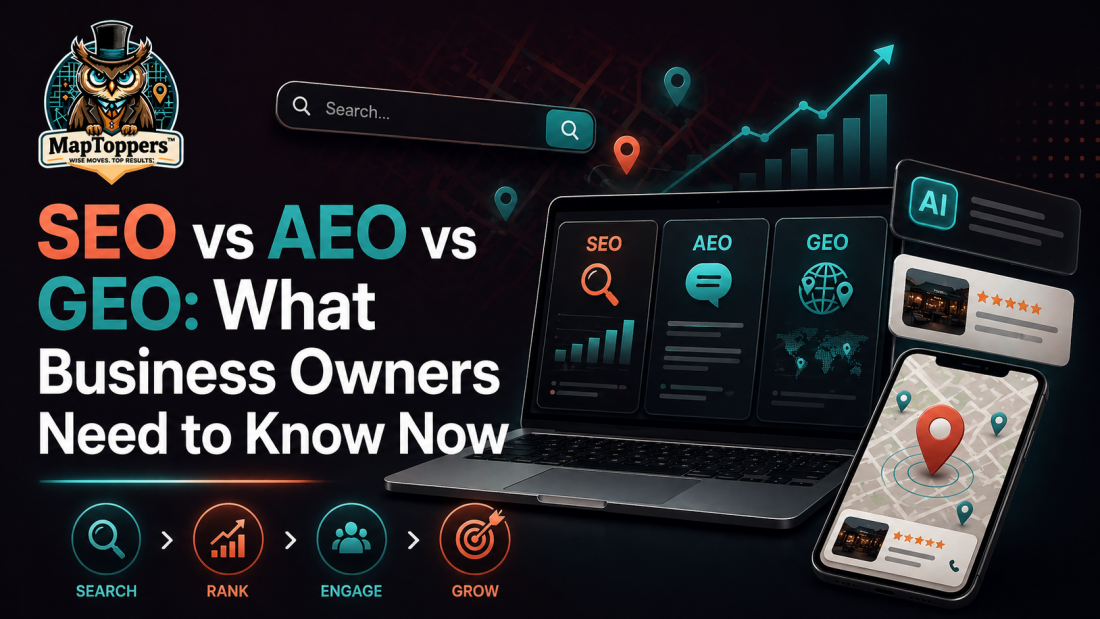
SEO helps your business rank.
AEO helps your business answer.
GEO helps your business get understood and found by AI.
If you are a local business owner, service provider, contractor, medical or dental practice, real estate professional, or small business trying to get more visibility online, these three concepts matter.
The good news? You do not need to throw away your current marketing strategy.
You just need to understand how search is evolving and how your business can stay visible.
What Is SEO?
SEO stands for Search Engine Optimization.
It is the process of improving your website and online presence so your business can show up higher in search engines like Google.
For local businesses, SEO helps you appear when people search for services in your area.
Examples include:
- “plumber near me”
- “dentist in Queens”
- “local SEO company”
- “pressure washing Savannah GA”
- “court reporter Sarasota”
- “roof repair near me”
- “Google Business Profile SEO”
- “local SEO services”
SEO helps Google understand:
- Who your business is
- What services you offer
- Where you provide those services
- Why your business is trustworthy
- Which searches your website should appear for
For small businesses, SEO is still one of the most important parts of digital marketing.
Why?
Because people still go to Google when they need something.
They search before they call.
They compare before they book.
They read reviews before they trust.
They check your website before they make a decision.
So yes, SEO is still very much alive.
It is just no longer the only piece of the visibility puzzle.
What Is AEO?
AEO stands for Answer Engine Optimization.
AEO is about making your content easy to understand and easy to use as an answer.
Instead of only thinking about keywords, AEO focuses on the questions your customers are asking.
For example:
- “What is local SEO?”
- “How long does SEO take?”
- “Why is my Google Business Profile not ranking?”
- “How much does pressure washing cost?”
- “Is a game truck better than a bounce house?”
- “How do I choose the right dentist?”
- “What should I look for before hiring a contractor?”
These are not just keywords.
They are real questions from real people who are trying to make decisions.
AEO helps your website answer those questions clearly.
This matters because search engines and AI-powered tools often look for direct, helpful answers. If your content is clear, organized, and useful, it has a better chance of showing up in answer-style results.
AEO can support:
- Featured snippets
- FAQ results
- Voice search
- Google AI answers
- Blog visibility
- Service page visibility
- Customer trust
- Conversion rates
In simple terms, AEO helps your business become the helpful answer customers are looking for.
What Is GEO?
GEO stands for Generative Engine Optimization.
This is the newest of the three.
GEO is about helping your business become easier for AI-powered tools to understand, summarize, mention, or reference.
Generative search tools include platforms and features such as:
- ChatGPT
- Gemini
- Perplexity
- Claude
- Bing Copilot
- Google AI Overviews
- Other AI-powered search tools
These tools do not always work like traditional search engines.
Instead of showing a long list of links, they often generate a full answer for the user.
For example, someone may ask:
- “What is the best marketing strategy for a local service business?”
- “How can a small business improve Google visibility?”
- “What should I look for in a local SEO company?”
- “How do I know if my Google Business Profile is optimized?”
- “What is the difference between SEO, AEO, and GEO?”
AI tools may respond with a summary, checklist, explanation, recommendation, or list of possible sources.
GEO helps your business prepare for that kind of search.
It focuses on making your content:
- Clear
- Helpful
- Well-structured
- Trustworthy
- Specific
- Easy to summarize
- Easy to understand
- Supported by strong brand signals
The goal of GEO is not to “trick” AI.
The goal is to make your business and content so clear that both humans and AI tools can understand what you do, who you help, and why you are credible.
SEO vs AEO vs GEO: The Simple Difference
Here is the easiest way to understand the difference.
SEO Helps You Rank
SEO focuses on traditional search visibility.
It helps your business show up in:
- Google Search
- Google Maps
- Organic search results
- Local map pack results
- Service-related searches
- Location-based searches
SEO is best for:
- Ranking service pages
- Ranking location pages
- Improving website traffic
- Improving Google Business Profile visibility
- Getting found by nearby customers
- Building long-term search visibility
Example:
A homeowner searches “roof repair near me.”
SEO helps a roofing company appear in Google search results and Google Maps.
AEO Helps You Answer
AEO focuses on answering questions clearly.
It helps your business show up when people ask:
- What is this?
- How does this work?
- How much does it cost?
- Is this worth it?
- What should I choose?
- What are the signs I need this service?
- How do I compare my options?
AEO is best for:
- FAQs
- Blog posts
- How-to guides
- Comparison content
- Featured snippets
- Voice search
- Educational content
- Customer decision-making
Example:
A homeowner searches “how do I know if I need roof repair?”
AEO helps the roofing company provide a clear, helpful answer.
GEO Helps AI Understand Your Business
GEO focuses on AI-powered search and generated answers.
It helps your business become easier for AI tools to understand.
GEO is best for:
- AI search visibility
- Brand mentions
- Clear service explanations
- Expert content
- Trust-building pages
- Structured content
- Helpful educational resources
- Strong online credibility
Example:
A homeowner asks an AI tool, “What should I look for before hiring a roofing company?”
GEO helps the roofing company’s content become useful, clear, and trustworthy enough to be understood in that type of AI-driven search journey.
Why Business Owners Should Care
This matters because customer behavior is changing.
People are no longer searching in only one way.
Today, customers may use:
- Short Google searches
- “Near me” searches
- Full question searches
- Voice search
- AI tools
- Google Maps
- Review platforms
- Social media
- Comparison searches
- Problem-based searches
A customer may not simply type:
“local SEO company”
They may ask:
“What is the best way for my small business to rank higher on Google?”
Or:
“Why is my competitor showing up before me on Google Maps?”
Or:
“How do I know if my website is hurting my leads?”
This is why your business needs content that does more than repeat keywords.
Your content needs to educate, answer, explain, and build trust.
Visibility Is Bigger Than Rankings Now
Ranking on Google is still important.
But online visibility now includes more than just being on page one.
Your business visibility may include:
- Google Search results
- Google Maps
- Google Business Profile
- Website content
- Blog articles
- FAQs
- Featured snippets
- AI-generated answers
- Reviews
- Local listings
- Social media profiles
- Directory mentions
- Brand mentions
- Customer testimonials
The real goal is not just traffic.
The real goal is:
- More calls
- More website visits
- More quote requests
- More booked appointments
- More form submissions
- More qualified leads
- More customer trust
That is why SEO, AEO, and GEO should work together.
Each one supports a different part of the customer journey.
Why SEO Is Still the Foundation
Let’s be clear: SEO is not dead.
Every few years, someone says SEO is dead.
Then business owners still go to Google, search for services, compare companies, read reviews, and call the businesses they find.
SEO is still the foundation because your website and Google Business Profile remain central to your online presence.
Strong SEO helps Google understand your business.
It also helps customers understand your business.
A strong SEO foundation includes:
- Keyword research
- Website optimization
- Google Business Profile optimization
- Service pages
- Location pages
- Blog content
- Technical SEO
- Internal linking
- Local citations
- Reviews
- Mobile-friendly design
- Fast page speed
- Clear calls to action
Without SEO, AEO and GEO become much harder.
Why?
Because answer engines and AI tools still need strong content to pull from, understand, and summarize.
If your website is thin, outdated, confusing, or missing important pages, you are making it harder for both Google and AI platforms to understand your business.
Example: SEO for a Local Roofing Company
Let’s say you own a roofing company.
A weak website might only have:
- A homepage
- A short about page
- A contact page
- One basic service page
That does not give Google much to work with.
A stronger SEO structure would include pages for:
- Roof repair
- Roof replacement
- Emergency roof repair
- Storm damage roof repair
- Commercial roofing
- Residential roofing
- Roof inspections
- Service area pages
- FAQs
- Blog content
This helps Google understand your services.
It also helps customers find exactly what they need.
If someone searches “emergency roof repair near me,” a specific emergency roofing page has a better chance of being relevant than a general homepage.
That is why SEO structure matters.
Why AEO Matters for Customer Questions
Customers ask questions before they buy.
They want to feel informed before they call, book, or request a quote.
They want to know:
- What does this service include?
- How much does it cost?
- How long does it take?
- Is it worth it?
- Do I really need this?
- What are my options?
- What should I watch out for?
- How do I choose the right company?
AEO helps your business answer those questions.
This is powerful because helpful answers build trust.
When your website explains things clearly, customers feel more confident choosing you.
They do not feel confused.
They do not feel pressured.
They do not feel like they need a marketing dictionary just to understand your services.
That matters.
Confused people usually do not convert.
Confident people are more likely to take action.
How to Optimize for AEO
AEO does not need to be complicated.
Start by making your content more question-friendly.
Use:
- Question-based headings
- Short, direct answers
- FAQ sections
- How-to guides
- Comparison blogs
- Pros and cons sections
- Step-by-step explanations
- Simple definitions
- Clear examples
- Helpful summaries
For example, instead of only writing a page titled:
“Boiler Services”
You could include questions like:
- “How often should a boiler be serviced?”
- “What are signs your boiler needs repair?”
- “Should I repair or replace my boiler?”
- “How long does boiler installation take?”
This helps customers.
It also helps search engines understand that your page answers real questions.
AEO Examples for Service Businesses
A dentist could answer:
- “Is Invisalign better than braces?”
- “How long does teeth whitening last?”
- “Are dental implants worth it?”
- “What is the difference between a crown and a veneer?”
A contractor could answer:
- “When should I replace my boiler?”
- “What are signs my roof needs repair?”
- “How long does a kitchen remodel take?”
- “Is a tankless water heater worth it?”
A court reporting company could answer:
- “What is included in deposition services?”
- “Can depositions be done remotely?”
- “What is an expert witness deposition?”
- “How do I schedule a court reporter?”
A local SEO company like MapToppers could answer:
- “Why is my business not showing up on Google?”
- “How does Google Business Profile SEO work?”
- “How long does local SEO take?”
- “What is the difference between SEO, AEO, and GEO?”
These questions create content that is useful, searchable, and conversion-friendly.
Why GEO Matters for AI Search
AI tools are becoming part of how customers research, compare, and make decisions.
A customer may ask an AI tool:
- “What should I look for in a local SEO company?”
- “How can I improve my Google Business Profile?”
- “What are the best marketing strategies for a small business?”
- “How do I choose a contractor near me?”
- “What questions should I ask before hiring a dentist?”
The AI tool may provide a summary, checklist, or recommendation.
This is where GEO becomes important.
GEO helps your business create content that AI tools can better understand.
That means your content should be:
- Clear
- Accurate
- Helpful
- Well-organized
- Specific
- Easy to summarize
- Supported by real expertise
- Connected to your services
- Locally relevant when appropriate
The stronger and clearer your content is, the more prepared your business is for AI-powered search.
What GEO Looks For
GEO is still developing, but strong AI-friendly content usually includes:
- Clear service descriptions
- Detailed FAQs
- Helpful educational content
- Consistent business information
- Strong website structure
- Reviews and testimonials
- Trust signals
- Local relevance
- Expert explanations
- Original insights
- Easy-to-read formatting
- Clear headings and subheadings
For local businesses, GEO also depends on your overall online presence.
Your website should match your Google Business Profile.
Your service pages should match what you actually offer.
Your business information should be consistent.
Your content should show that you understand your industry and your customers.
AI tools need context.
Your job is to provide that context clearly.
A Quick Note About GEO Promises
Business owners should be careful about anyone who promises guaranteed AI mentions or citations.
GEO is still new.
AI tools change often.
No honest marketing company should promise that your business will appear in every AI response.
A good GEO strategy can improve your chances by making your content clearer, more helpful, better structured, and more trustworthy.
That is the smart approach.
No hype.
No magic tricks.
Just better content and stronger digital signals.
How SEO, AEO, and GEO Work Together
The best strategy does not choose one and ignore the others.
SEO, AEO, and GEO are connected.
Think of them as three layers.
Layer 1: SEO
SEO builds the foundation.
It helps your business rank in Google and Google Maps.
This includes:
- Website optimization
- Google Business Profile optimization
- Service pages
- Location pages
- Keyword targeting
- Technical SEO
- Reviews
- Citations
Layer 2: AEO
AEO makes your content more answer-friendly.
It helps customers and search engines quickly understand your information.
This includes:
- FAQs
- Question-based headings
- Direct answers
- Comparison blogs
- How-to content
- Educational guides
Layer 3: GEO
GEO prepares your content for AI-powered discovery.
It helps AI tools better understand your business and content.
This includes:
- Structured content
- Clear explanations
- Expert insights
- Strong trust signals
- Consistent business information
- Helpful, original content
Together, these layers create stronger visibility.
SEO helps you get found.
AEO helps you be useful.
GEO helps AI understand you.
That is the sweet spot.
Example: Local HVAC Company
Let’s look at a local HVAC company.
SEO Strategy
The business creates optimized service pages for:
- Boiler repair
- Heating repair
- Tankless water heater installation
- Emergency HVAC service
- Radiant heating systems
- Service area pages
This helps the company rank for local service searches.
AEO Strategy
The business creates helpful content answering:
- “How often should a boiler be serviced?”
- “What are the signs your water heater needs replacement?”
- “Is a tankless water heater worth it?”
- “Why is my heating system making noise?”
- “Should I repair or replace my boiler?”
This helps customers get answers before calling.
GEO Strategy
The business strengthens its AI-readiness with:
- Detailed service pages
- Clear FAQs
- Local expertise
- Customer reviews
- Case studies
- Consistent business information
- Helpful blog content
- Strong internal linking
This helps AI tools better understand what the company does, where it works, and why it is trustworthy.
The result?
A stronger online presence across traditional search, answer-based search, and AI-powered search.
Common Mistakes Business Owners Make
Many business owners want better visibility but accidentally hold themselves back.
Here are the most common mistakes.
Mistake 1: Only Focusing on Keywords
Keywords matter.
But keywords alone are not a strategy.
You also need:
- Helpful content
- Strong service pages
- Technical SEO
- Local relevance
- Google Business Profile optimization
- Reviews
- Clear calls to action
- Trust signals
If you only repeat keywords without creating useful content, your website may feel robotic and thin.
Google does not want that.
Customers do not want that either.
Mistake 2: Ignoring Google Business Profile
For local businesses, your Google Business Profile is a major visibility tool.
It can influence:
- Local map rankings
- Phone calls
- Website visits
- Direction requests
- Customer trust
- Review visibility
- First impressions
A strong profile should include:
- Correct business name
- Accurate phone number
- Website link
- Updated hours
- Proper categories
- Complete services
- Fresh photos
- Customer reviews
- Review responses
- Google Business posts
Your Google Business Profile should not sit there collecting digital dust.
It should be active, accurate, and optimized.
Mistake 3: Writing Thin Service Pages
A service page with only a few sentences is usually not enough.
Customers need details.
Google needs details.
AI tools need details.
A strong service page should explain:
- What the service is
- Who it is for
- Why it matters
- What problems it solves
- What areas you serve
- What makes your business different
- Common questions
- Next steps
- How to contact you
Thin pages are easy to ignore.
Helpful pages are easier to rank, understand, and trust.
Mistake 4: Not Answering Customer Questions
If your website does not answer common customer questions, you may lose leads.
People may leave your website and keep searching.
That means they may find a competitor who explains things better.
Add FAQs to:
- Service pages
- Location pages
- Blog posts
- Contact pages
- Main landing pages
Good FAQs support SEO, AEO, GEO, and conversions.
They are small sections that can do a lot of heavy lifting.
Mistake 5: Chasing AI Trends Before Fixing the Basics
GEO is important.
But do not chase AI visibility before fixing your foundation.
Before worrying about AI search, make sure your business has:
- A clear website
- Strong service pages
- Optimized Google Business Profile
- Accurate citations
- Helpful content
- Good reviews
- Fast mobile experience
- Working contact forms
- Clear calls to action
AI-readiness starts with clarity.
If your website is confusing for people, it is probably confusing for search engines and AI tools too.
Mistake 6: Not Tracking Results
You cannot improve what you do not track.
Business owners should pay attention to:
- Keyword rankings
- Website traffic
- Calls
- Form submissions
- Google Business Profile clicks
- Direction requests
- Review growth
- Lead quality
- Conversion rates
- Pages that bring traffic
- Pages that need improvement
Tracking helps you make smarter decisions.
Without tracking, you are guessing.
And guessing is not a strategy.
It is just marketing with a blindfold.
What Business Owners Should Do First
If SEO, AEO, and GEO feel like a lot, start simple.
You do not need to do everything at once.
Start with the areas that create the strongest foundation.
Step 1: Audit Your Website
Look at your website honestly.
Ask:
- Does it clearly explain what we do?
- Does it show where we provide services?
- Are our main services easy to find?
- Is the phone number visible?
- Are the contact forms working?
- Does the website load quickly?
- Does it work well on mobile?
- Are our pages helpful or too thin?
- Do we have clear calls to action?
- Do we answer customer questions?
A website audit can reveal issues that are quietly costing you leads.
Step 2: Review Your Google Business Profile
Check your Google Business Profile for accuracy and completeness.
Review:
- Business categories
- Services
- Business description
- Hours
- Phone number
- Website link
- Photos
- Reviews
- Review responses
- Service areas
- Posts
- Products or service highlights
For many customers, your Google Business Profile is the first thing they see.
Make sure it represents your business well.
Step 3: Add FAQs and Question-Based Content
Start collecting the questions your customers already ask.
These may come from:
- Sales calls
- Emails
- Consultations
- Reviews
- Customer objections
- Search results
- Competitor websites
- Google’s “People also ask” section
- Your team’s experience
Turn those questions into content.
Use them in:
- Blog posts
- Service pages
- FAQs
- Google Business posts
- Social media captions
- Videos
- Email newsletters
This supports AEO and helps customers feel more informed.
Step 4: Improve Your Service Pages
Each main service should have its own strong page.
A good service page should include:
- Clear service name
- Simple explanation
- Benefits
- Common problems it solves
- Who needs the service
- Local relevance
- Process or expectations
- Trust signals
- FAQs
- Strong CTA
For example, if you are a contractor, do not put everything on one general “Services” page.
Create separate pages for your main services.
This makes your website easier to understand and easier to rank.
Step 5: Create a Content Plan
Random content rarely works well.
Create a plan around what your customers actually need to know.
Your content plan can include:
- Educational blogs
- Service-focused blogs
- Comparison articles
- FAQs
- Location pages
- Google Business posts
- Case studies
- Seasonal content
- Buying guides
- Problem-solution articles
For example, a local SEO company could create content like:
- “What Is Local SEO?”
- “Why Is My Business Not Showing Up on Google?”
- “How to Optimize Your Google Business Profile”
- “SEO vs AEO vs GEO”
- “How Website Audits Help Small Businesses Get More Leads”
This builds topical authority and customer trust over time.
Step 6: Track What Matters
Do not only track rankings.
Track business results.
Important metrics include:
- Phone calls
- Website visits
- Form submissions
- Google Business Profile clicks
- Keyword movement
- Local map rankings
- Blog traffic
- Service page traffic
- Lead quality
- Conversion rate
Rankings are helpful.
Leads are better.
Revenue is the real goal.
How MapToppers Helps Businesses With SEO, AEO, and GEO
At MapToppers, we help service-based businesses improve online visibility with clear, practical digital marketing strategies.
We know most business owners do not want confusing reports or technical explanations that sound like they were written by a robot wearing a suit.
You want to know:
- Why am I not ranking?
- Why am I not getting more calls?
- What is wrong with my website?
- Is my Google Business Profile optimized?
- What content do I need?
- What are my competitors doing better?
- What should I fix first?
That is where we help.
MapToppers provides:
- Local SEO strategy
- Google Business Profile optimization
- Website audits
- Keyword research
- SEO content writing
- Technical SEO
- Service page optimization
- Location page strategy
- Google Business posts
- Citation support
- AEO-friendly FAQs
- GEO-ready content structure
- Lead generation support
- Digital marketing strategy
Our goal is to help your business become easier to find, easier to trust, and easier to contact.
Because visibility is good.
Qualified leads are better.
Final Thoughts: SEO, AEO, and GEO Work Better Together
Search is not standing still.
Customers are using Google, Google Maps, voice search, AI tools, review platforms, and question-based searches to find businesses and make decisions.
That means your business needs a stronger and clearer online presence.
Here is the simple takeaway:
- SEO helps your business rank.
- AEO helps your business answer.
- GEO helps AI understand your business.
You do not need to choose only one.
You need all three working together.
Start with a strong SEO foundation.
Add helpful answers for your customers.
Structure your content clearly for the future of AI-powered search.
That is how your business can stay visible, trusted, and competitive.
Request a Free Google Business and Website Audit
Want to know how your business is showing up online?
MapToppers is offering a free Google Business and website audit to help you understand what is working, what is missing, and where your best opportunities are.
Call 786-438-0076 or email info@maptoppers.com to request your free audit.
Let’s help your business get found, trusted, and chosen.
FAQs
1. What is the difference between SEO, AEO, and GEO?
SEO helps your business rank in search engines like Google. AEO helps your content answer customer questions clearly. GEO helps your business become easier for AI-powered tools to understand, summarize, mention, or reference.
In simple terms:
- SEO helps you rank.
- AEO helps you answer.
- GEO helps AI understand you.
2. Is SEO still important with AI search?
Yes, SEO is still important.
AI search has changed how people find information, but SEO remains the foundation of online visibility. Your website, Google Business Profile, service pages, reviews, and local content still help search engines and AI tools understand your business.
Without strong SEO, AEO and GEO become harder to build.
3. What is AEO in simple terms?
AEO means Answer Engine Optimization.
It is the process of creating content that answers customer questions clearly and directly.
Examples include:
- FAQs
- How-to guides
- Comparison blogs
- Short explanations
- Question-based headings
- Helpful service page content
AEO helps your business show up when people search using questions.
4. What is GEO in digital marketing?
GEO means Generative Engine Optimization.
It focuses on making your content easier for AI tools to understand and use in generated answers.
GEO includes clear service descriptions, helpful content, FAQs, trust signals, local relevance, strong website structure, and consistent business information.
5. Should small businesses focus on SEO, AEO, or GEO first?
Small businesses should start with SEO first because it is the foundation.
Once your website, Google Business Profile, service pages, and local visibility are strong, you can build on that with AEO and GEO.
The best strategy is not SEO vs AEO vs GEO.
The best strategy is SEO plus AEO plus GEO.